How to Write a Surfboard Shaping Brief
- Describe the ride before prescribing the board
- Write the surfer snapshot
- State priorities and non-negotiables
- Treat dimensions as interacting variables
- Connect rocker, bottom, rails, and tail
- Specify the fin conversation
- Put build safety outside the design fantasy
- End with questions, not fake certainty
- Sources
Describe the ride before prescribing the board
A surfboard shaping brief should explain the surfer, usual waves, current board, desired change, and practical constraints before listing dimensions. Then it can describe an outline, rocker direction, rail feel, bottom idea, tail, and fin setup as a connected proposal. The brief is a conversation tool for an experienced shaper, not a shopping list that guarantees performance.
Begin with what happens on the water. “Make it 2⅜ inches thick” is a measurement. “I want earlier entry without losing the ability to redirect in waist- to head-high beach-break surf” is a design problem worth solving.
Write the surfer snapshot
Record information the shaper can actually use:
- Height and weight, measured rather than remembered generously.
- Experience and realistic paddling fitness.
- Stance, including regular or goofy and any unusual foot placement.
- Usual wave size, power, surface, break type, and crowding.
- The board used most now, including dimensions and construction if known.
- What that board does well.
- The moment it begins to feel difficult.
- The one or two changes wanted from the new board.
Avoid reducing ability to labels such as beginner or advanced. Two surfers using the same label can have different takeoff habits, speeds, injuries, and waves. Video, honest examples, and the current board often communicate more than aquatic autobiography.
State priorities and non-negotiables
Rank the goals. A board asked to maximize early entry, tiny storage, high-speed hold, loose turning, heavy durability, low weight, and modest cost may respond by becoming imaginary.
Write three headings:
- Must do: the central job and conditions.
- Nice to have: benefits worth a tradeoff.
- Avoid: behaviors, construction issues, or physical demands that make the board unsuitable.
Include travel limits, budget range, construction preferences, repair access, environmental priorities, and any clinician-imposed restriction. Do not ask a shaper to diagnose shoulder, back, balance, or mobility problems; obtain healthcare advice separately and translate relevant constraints with permission.
Treat dimensions as interacting variables
Length, width, thickness, outline, and volume do not operate independently. The same stated volume can be distributed through very different rails, decks, noses, and tails. A liter figure alone cannot describe how a board paddles, engages a rail, or fits under an arm.
Instead of copying dimensions from a favorite professional's board, explain where you want area and foam to support the intended use. Discuss the wide point, nose width, tail width, rail volume, and foil from nose to tail. Let the shaper reconcile those choices with blank availability, construction, rider, and conditions.
If making a drawing, label it as a concept rather than a production template. Check left-right symmetry and mark a centerline. A seductive curve on a phone screen still needs to become a fair, buildable line at full scale.
Connect rocker, bottom, rails, and tail
Rocker is the board's longitudinal curve. Entry and tail rocker affect how the board meets water and transitions through turns, but more or less is not universally better. Bottom contours, rail shape, outline, fin placement, and surfer input change the result.
Describe desired sensations and problems: catching the nose on steep entry, struggling to generate speed in weak surf, losing hold at pace, or finding transitions sticky. Ask the shaper which rocker and bottom combination addresses those conditions without creating a worse tradeoff elsewhere.
Do the same for rails and tail. Terms such as full, pinched, hard, soft, squash, round, or pin are useful only when both people mean the same thing. Use reference boards the shaper can inspect and ask where the rail transitions. A tail name cannot explain the entire last third of a board any more than “boots” explains a hiking route.
Specify the fin conversation
Record the fin system, configuration options, and fins already owned, including their actual model and size when relevant. Do not set boxes by copying an isolated online number; placement interacts with tail width, rocker, bottom, rail, and intended feel. Installation also requires system-specific jigs, tolerances, resin compatibility, and structural knowledge.
If you want multiple configurations, state which one is primary. Additional boxes add options, weight, work, and potential leak or failure points. Ask how each setup changes the design rather than treating empty boxes as free insurance.
Put build safety outside the design fantasy
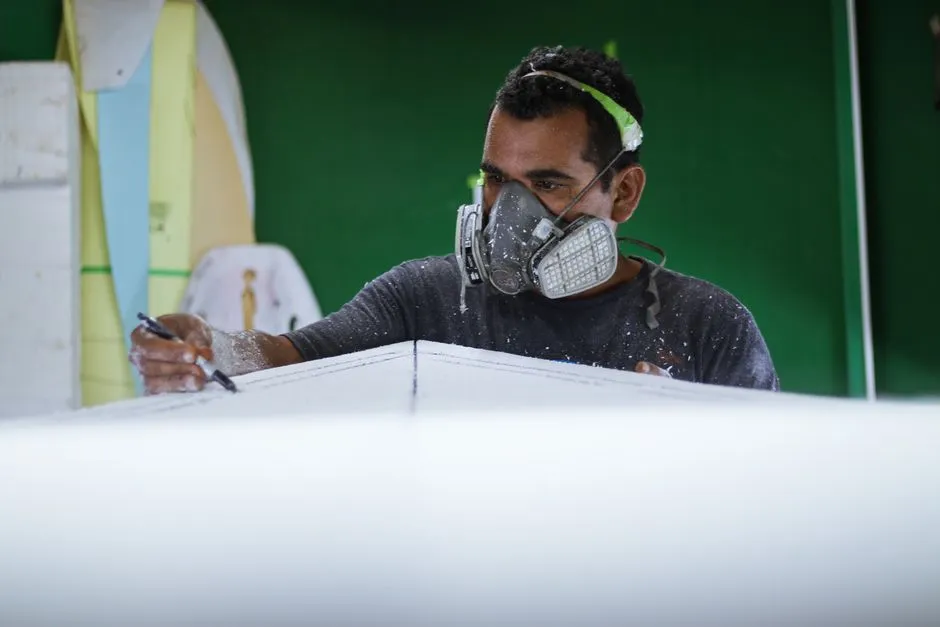
Shaping and glassing can generate airborne foam, fiberglass, filler, and cured-resin dust, while liquid resin and solvents can expose skin and lungs. NIOSH evaluations support local exhaust for sanding and appropriate protective controls for epoxy work. Product chemistry varies, so read current safety data sheets and labels, use properly designed ventilation, and obtain competent help selecting gloves, eye protection, clothing, and any respiratory program.
A dust mask chosen by vibes is not an exposure-control plan. Do not shape or glass in living space, near children, food, ignition sources, or uncontrolled drains. Follow fire, waste, environmental, and workplace rules. A professional bay with extraction and experienced supervision is the sensible starting point.
End with questions, not fake certainty
Attach the surfer snapshot, goals, current-board notes, sketches, construction constraints, fin details, and unresolved questions. Then invite the shaper to challenge assumptions. Browse shape planning for more ways to compare concepts, and use an after-surf board care routine once the finished board reaches water.
The best brief makes tradeoffs visible. It does not remove the craft from shaping; it gives the craft a clear problem to solve.